Contents:
Cooling the laser 在线成人一区二区 is important in the operation of the equipment. In this article we will tell you how to choose the cooling equipment for your 在线成人一区二区.
CNC laser 在线成人一区二区s have proven themselves to be a versatile and easy-to-use tool for processing a wide range of materials. Due to the high speed and quality of processing, laser equipment is firmly “settled” in a number of 天堂www中文在线资源 niches (for example, in the advertising, textile, souvenir, jewelry industry, and others). This is largely facilitated by small (in comparison with similar equipment) price of CNC laser 在线成人一区二区s. As well as a wide model range, the presence of 在线成人一区二区s with different working area size, the values of the nominal laser power, etc.
Laser 在线成人一区二区s with a gas mixture as an active medium are widely used. A mixture of carbon dioxide, nitrogen and helium serves for generation of radiation in them. Gas lasers provide a stable flow of radiation in different ranges of power change. This improves the quality of processing products. In addition, the specific processing cost for this type of laser is very low, which has a positive effect on reducing 天堂www中文在线资源 costs.
However, a significant disadvantage of CO2 gas lasers is the high level of heat generation during operation. Moreover, excess heat negatively affects the laser tube itself, significantly reducing its working life. To extend the “durability” of the tube, it is mandatory to remove excess heat. This task is assigned to the cooling system of the laser 在线成人一区二区.
What is a chiller?
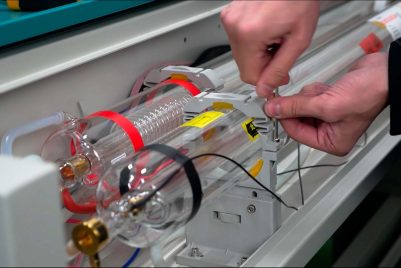
The design of the cooling system for the laser 在线成人一区二区 is very simple. The tube with the active gas mixture sealed inside has double walls of the body, the space between which is used for passing the cooling liquid. The liquid is taken by a special pump from the main tank, pumped through the laser tube, and then drained back. The same tank serves as a passive heat exchanger – the heated liquid in the tube is cooled when mixed with the main volume of water.
A passive system does not always provide the proper level of heat dissipation. You either have to add cold water to the container (risking contamination). Or periodically stop the laser 在线成人一区二区 to cool the entire mass of the liquid in a natural way. Of course, with the 在线成人一区二区 intensive 天堂www中文在线资源 this is unacceptable. In addition, to meet the required cooling conditions, the passive system requires a very large volume of liquid (about 100 l). This significantly increases the size of the system and requires a spacious room for the installation of the laser 在线成人一区二区.
But the main problem is the lack of precise control of the operating temperature. If you “miss” its excess (and you can only track it visually), the overheating of the liquid can “condemn” the laser tube.
Special devices, the chillers, are used for automation of cooling systems. The chiller contains a tank for cooling liquid, a built-in pump for pumping it through a laser tube and an active heat exchange system (tubular coils, freon or forced air circulation fans, plus temperature sensors with an automatic electronic control unit). By connecting the chiller to the laser 在线成人一区二区, filling the working fluid and setting the desired temperature “at the output” (for example, optimal for the laser tube 19-21 °C), you can “forget” about the cooling system. The desired temperature will be maintained automatically – even when the CNC laser 在线成人一区二区 is running at maximum power for a long time!
The selection criteria for the chiller
Speaking of a “professional chiller” we mean models with such parameters that will allow to effectively cool the laser 在线成人一区二区 regardless of its load (it is assumed that with “professional” use this load will be as intense as possible).
Chiller designs are divided into two types:
- with air cooling;
- with freon cooling.
What is the fundamental difference?
The fact is that the air chiller will not be able to cool the liquid below the temperature that is available in the room! After all, without freon (refrigerant), the air unit simply has nowhere to “take the cold”. In addition, air chillers are often positioned as “initial models”, so they may lack important functions (for example, automatic monitoring and warning of exceeding the user-defined coolant temperature).
Thus, the only advantage of the air chiller (in comparison with the passive cooling system of the laser 在线成人一区二区) is the reduction of the required liquid capacity (up to 9-10 liters). However, it is not necessary to rely on automatic temperature maintenance in a wide range of changes in the load of the laser 在线成人一区二区 (and the ambient temperature in the 天堂www中文在线资源 room) when using an air chiller.
The scope of application of air chillers: CNC laser 在线成人一区二区s equipped with tubes with a capacity of no more than 60 watts. For more powerful 在线成人一区二区s, the coolant overheats after 15 minutes of continuous processing.
Freon-cooled chiller
Freon cooling allows you to further reduce the required volume of coolant (up to 5-7 liters), while ensuring that the level of the user-defined temperature is maintained automatically. When using such a chiller, the laser 在线成人一区二区 can work twenty-four hours without any hint of overheating.
The chiller is suitable for laser 在线成人一区二区s with tubes up to 100 W or more (in this case, a freon chiller with a large volume of built-in capacity is required). Or one freon chiller can be installed to cool two 在线成人一区二区s simultaneously with 60 W and 90 W tubes (or other combination). However, in this case, both 在线成人一区二区s should not work for a long time at maximum power.
What is to fill?
For passive cooling systems, laser equipment 久久娱乐网s recommend (allow) the use of clean tap water. However, due to the large differences in water hardness, it is better to use distilled water. For all models of chillers, distilled water is the only acceptable “water” refrigerant!
You can also use antifreeze to fill the chiller. But only if the chiller and cooling system of the laser 在线成人一区二区 had not been filled with ordinary water before. Otherwise, the system must be thoroughly rinsed with distilled water before filling the antifreeze.